

DEGRES INX Resin Successfully Printed Aboard the International Space Station
Shape-memory resin used by Auxilium Biotechnologies to manufacture nerve repair implants in orbit
Zwijnaarde, Belgium August 21, 2026 – BIO INX is proud to announce that its polyester-based shape-memory resin, DEGRES INX®, has been successfully used for 3D printing aboard the International Space Station (ISS).
Auxilium Biotechnologies used DEGRES INX® to manufacture nerve repair scaffolds in orbit with its autonomous AMP-1 bioprinting platform. The printing took place during Mission AXLM-3, which flew aboard NASA’s SpaceX CRS-34 mission and returned to Earth on June 17, 2026, splashing down off the coast of California.
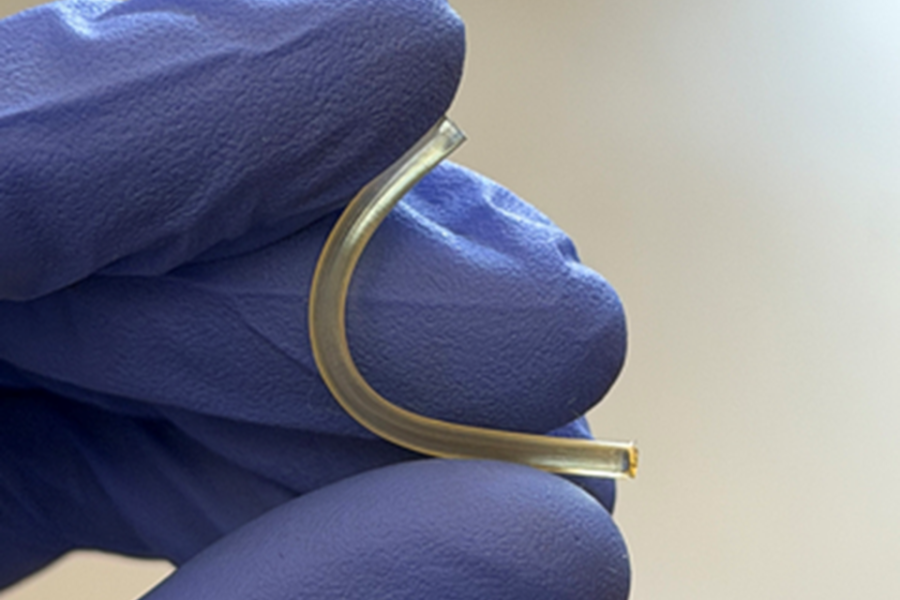
During the mission, AMP-1 produced 28 nerve repair implants alongside kidney, liver, and cartilage tissue constructs. According to Auxilium, this was the first mission in which a single orbital manufacturing platform produced both living tissues and implantable medical devices during the same spaceflight. It was also the first reported manufacturing of kidney and liver tissue in space.
3D printed nerve repair Implant printed aboard the International Space Station using BIO INX’ DEGRES INX resin (image courtesy of Auxilium Biotechnologies).
The kidney and liver tissues were produced using cells and tissue designs provided by the Wake Forest Institute for Regenerative Medicine, while Auxilium supplied the orbital biomanufacturing platform.
“This mission marks an exciting step forward for in-space biomanufacturing and demonstrates what can be achieved when innovative technology is paired with strong collaboration,” said Isac Lazarovits, Vice President of Engineering at Auxilium Biotechnologies. “Demonstrating multiple product classes and meaningful production volume within a single mission is an important milestone as we continue advancing toward routine manufacturing operations in orbit.”
Why manufacture biological structures in space?
Microgravity offers unique conditions for biofabrication. On Earth, gravity can cause cells and other components to settle unevenly while soft, delicate structures may deform or collapse under their own weight. In microgravity, cells can be distributed more uniformly throughout a construct, while complex geometries—including internal voids, cavities, and channels—can be created without the same gravitational constraints.
These conditions could support the development of increasingly sophisticated tissue constructs, biomedical research models, and implantable devices that are difficult to manufacture on Earth.
From light to life; and now into orbit
“At BIO INX, we are incredibly proud to see our resin successfully printed in space for the first time,” said Jasper Van Hoorick, CEO and co-founder of BIO INX. “We look forward to continuing to support the Auxilium team in its broader strategy to establish a versatile manufacturing platform capable of producing multiple tissue and medical-device types during a single flight.”
“Alongside the manufacturing platform itself, the bioresins must be sufficiently robust, reproducible, and versatile,” Van Hoorick continued. “This aligns perfectly with BIO INX’s mission to develop standardized, high-performing materials with true plug-and-print capabilities. Reliable printing at the press of a button is valuable on Earth, but it becomes absolutely essential during space missions, where astronaut time and resources are extremely limited.”
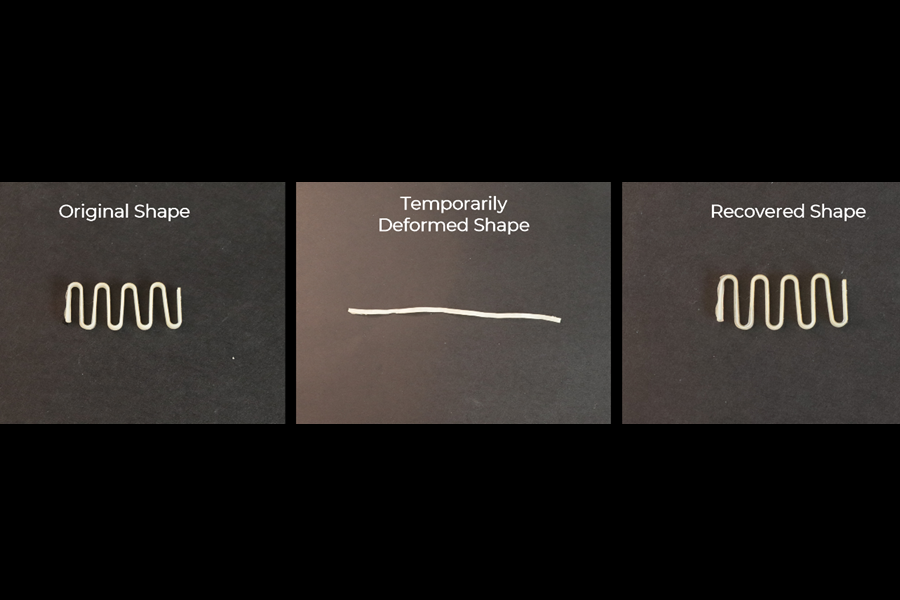
DEGRES INX® is BIO INX’s biodegradable, polyester-based resin developed for light-based 3D printing. Its shape-memory properties enable printed structures to be temporarily deformed and subsequently recover their original geometry—an attractive feature for minimally invasive and implantable biomedical applications.
The successful use of DEGRES INX® aboard the ISS represents an important milestone for BIO INX and demonstrates how standardized biomaterials can support advanced manufacturing under some of the most demanding conditions imaginable.
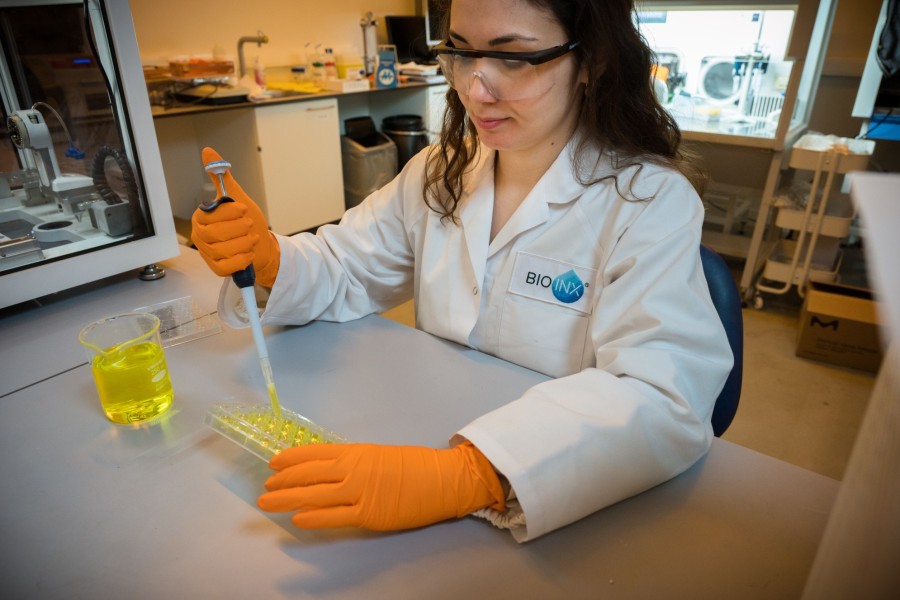
BIO INX’ CSO Aysu Arslan working in the lab using the DEGRES INX formulation.
Building the future of orbital biomanufacturing
The AXLM-3 mission forms part of Auxilium’s broader effort to move beyond individual proof-of-concept experiments and establish a scalable orbital platform capable of producing multiple tissue and device types within a single flight.
Auxilium is collaborating with Vast Space and Starlab Space on future orbital manufacturing capabilities as commercial space stations prepare to succeed the ISS. Its partnership with Starlab aims to bring in-orbit bioprinting and biofabrication to Starlab’s planned commercial space station. Auxilium is also developing capabilities intended to support future lunar and deep-space missions.
The mission was supported by BioServe Space Technologies, Space Tango, NASA’s InSPA program, and the astronauts aboard the International Space Station.
About BIO INX
BIO INX is a Belgian biomaterials company specializing in standardized, reproducible bioinks and biomaterial formulations for light-based 3D bioprinting. Through its ready-to-use materials and Development-on-Demand services, BIO INX enables researchers and companies to transform innovative biofabrication concepts into reliable and scalable applications in regenerative medicine, drug development, and animal-free testing.